

Travel can be one of life’s most rewarding experiences, but the costs can add up quickly if you’re not careful. Airfare, accommodations, transportation, food, and unexpected expenses can all take a bigger bite out of your budget than expected. The good news is that a few smart strategies can help you keep costs under control without sacrificing the quality of your trip.
Whether you’re planning a quick getaway or a long international adventure, these travel money-saving tips can help you spend less and get more value from every dollar. From lowering transportation and accommodation costs to reducing food and travel expenses, these practical ideas can help make your next trip more affordable.
Disclaimer: This article is for informational purposes only. Prices, promotions, fees, and travel policies may change, so always verify details with airlines, hotels, and service providers before booking.
1. Book airport lounges through third-party apps
Airport lounges are no longer just for first-class travelers. Apps like LoungeBuddy and Priority Pass let you access comfortable lounges for a one-time fee that is often cheaper than buying food and drinks in the terminal. You get Wi-Fi, snacks, quiet seating, and sometimes showers, all of which make layovers and early departures so much more bearable.
Tip: Check the app before your trip to see which lounges are available at your departure airport and what the day pass costs.
2. Get a travel SIM card or international phone plan
Roaming charges from your home carrier can quietly add up to a surprising amount by the end of a trip. Picking up a local SIM card at your destination or activating an affordable international plan before you leave keeps you connected without the unexpected fees. Many destinations also have prepaid data options that cost only a few dollars for several days of coverage.
Tip: Research your carrier’s international day pass options before your trip and compare them against local SIM card prices at your destination.
3. Take advantage of free walking tours
Many cities around the world offer free walking tours led by local guides who work on a tips-only basis, meaning you pay what you feel the experience was worth. These tours are one of the best ways to get oriented in a new city, learn its history, and discover hidden spots you would never find on your own. You get a genuine local perspective without paying for an expensive guided excursion.
Tip: Search “free walking tour” plus your destination city before you travel and book a spot in advance since they often fill up quickly.
4. Carry a reusable water bottle with a filter
Buying bottled water every day while traveling adds up more than most people expect, especially in destinations where tap water is not safe to drink. A reusable bottle with a built-in filter lets you drink safely from most water sources without constantly spending money on single-use bottles. It is a small thing to pack that pays for itself pretty quickly.
Tip: Look for a filtered bottle designed for travel, such as the LifeStraw or Grayl options, which work in a wide range of water conditions.
5. Look for city passes and attraction bundles
Many popular travel destinations offer city passes that bundle entry to multiple museums, attractions, and transit into one discounted price. If you plan to visit more than two or three paid attractions in a single city, a pass almost always saves you money compared to buying tickets individually. Some passes also let you skip the regular entry lines, which is a great bonus during busy travel seasons.
Tip: Calculate the cost of the individual attractions you plan to visit and compare it against the pass price before purchasing to make sure it is actually worth it.
6. Use Google Maps offline to avoid data charges
Relying on live navigation while traveling internationally can drain your data quickly and rack up roaming charges if you are not on a local plan. Downloading your destination’s map on Google Maps before you leave gives you full turn-by-turn navigation without needing a data connection at all. It works just as well as the live version for getting around on foot or by transit.
Tip: Download the offline map for your destination city while still on Wi-Fi before you board your flight.
7. Eat at local markets instead of sit-down restaurants
Food markets, street stalls, and local vendors almost always offer fresher and more authentic food at prices that are a fraction of what you would pay at a tourist-facing restaurant. Some of the best meals you will have while traveling come from a simple market stall that locals have been going to for years. It is one of the easiest ways to eat well and stretch your daily food budget at the same time.
Tip: Search for the nearest local market or food hall when you arrive and make it your go-to spot for at least one meal a day.
8. Book activities directly with local operators
Third-party booking platforms for tours and activities are convenient but often add a noticeable markup on top of the base price. Going directly to a local tour company, guide, or activity provider either in person or through their own website usually gets you the same experience for less. You also have a more direct line of communication if anything needs to change.
Tip: Once you arrive at your destination, compare prices quoted directly by local operators against what you saw online before booking anything.
9. Use a VPN to find cheaper regional prices
Flight and hotel prices can vary depending on where your search is coming from since booking platforms sometimes show different rates based on your location. Switching your VPN to another country may sometimes reveal different regional prices for the same itinerary, although results vary by airline and booking platform. It only takes a few minutes to compare and see if there is any difference.
Tip: Try searching with your VPN set to the destination country or a nearby region and compare those results against what you see with your regular connection.
10. Book flights during off-peak travel seasons
Flying during shoulder seasons or off-peak months means significantly lower airfare since demand drops and airlines compete harder for bookings. You often get the same destination for a fraction of the high-season price just by shifting your trip by a few weeks. It is one of the simplest ways to save on flights without changing your destination at all.
Tip: Research your destination’s peak and off-peak seasons before booking and aim to travel during the quieter months whenever your schedule allows.
11. Clear your browser cookies before booking
Some travelers believe clearing cookies or starting a fresh browser session may help avoid personalized pricing, although evidence is mixed. Regardless, using a fresh browser session can make it easier to compare prices consistently across different booking sites.
Tip: Get into the habit of clearing cookies or using a fresh browser session every time you start a new travel search.
12. Compare prices across multiple booking platforms
No single platform consistently offers the lowest price on every route or hotel, so checking several sites before booking is always worth the extra few minutes. Expedia, Kayak, Booking.com, and Google Flights each pull from different sources and may show different deals.
Tip: Use a comparison tool like Google Flights or Kayak first, then check the airline or hotel’s own site directly.
13. Book hotels directly for better rates and perks
Hotels often match or beat third-party prices when you book through their own website, and they may throw in extras like free breakfast, room upgrades, or flexible cancellation. Going direct also means you’re dealing with the property itself if anything goes wrong.
Tip: Call the hotel directly and ask if they can offer a better rate or added perks before finalizing your booking.
14. Use hotel loyalty programs
Signing up for a hotel’s loyalty program is free and can earn you points toward free nights, member-only discounts, and other perks just for staying with them regularly. Even occasional travelers can benefit from these programs over time.
Tip: Join the loyalty programs of the hotel brands you stay with most often and always enter your number when booking.
15. Try hostels, guesthouses, or vacation rentals
Accommodation doesn’t have to mean a traditional hotel, and alternatives like hostels, locally run guesthouses, or vacation rentals can cost a fraction of the price while offering a more personal experience. These options are especially budget-friendly for longer trips.
Tip: Check Airbnb, Booking.com, and Hostelworld to compare alternative accommodation options for your destination.
16. Book refundable rates and watch for price drops
Booking a refundable rate upfront gives you the flexibility to rebook if the price drops before your trip, which happens more often than people realize. This strategy works especially well when you book early and keep an eye on prices in the weeks that follow.
Tip: Set a fare or hotel alert after booking so you’re notified if the price goes lower before your travel date.
17. Bundle flights and hotels in travel packages
Booking your flight and hotel together through platforms like Expedia or Priceline often comes with a bundled discount that you wouldn’t get booking separately. Package deals can save you a decent amount, particularly on popular routes and destinations.
Tip: Always compare the bundled price against booking separately to make sure the package is actually the better deal.
18. Use cashback portals for travel bookings
Sites like Rakuten or TopCashback give you a percentage of your booking back as cash or rewards when you click through to travel sites from their platform. It takes less than a minute to route your booking through one of these portals and the savings add up over time.
Tip: Download a cashback browser extension so you’re automatically reminded to activate cashback before completing any travel purchase.
19. Look for last-minute deals on apps like HotelTonight
Hotels would rather fill empty rooms at a discount than leave them vacant, which is why last-minute hotel apps can offer surprisingly steep discounts. HotelTonight specializes in same-day and short-notice bookings that can be well below standard rates.
Tip: If your travel plans are flexible, wait until the day of or a day before to check last-minute hotel apps for the best discounts.
20. Travel with carry-on only to avoid baggage fees
Checked baggage fees can add up fast, especially on budget airlines that charge for every bag on every leg of your trip. Packing light and fitting everything into a carry-on eliminates those fees entirely and makes getting around much easier.
Tip: Invest in a quality carry-on that meets most airline size requirements so you can skip baggage fees on every trip.
21. Take advantage of happy hour and lunch specials
Many restaurants offer significantly discounted menus during lunch hours or early evening happy hour windows that most tourists overlook. You can enjoy the same quality food and drinks from a sit-down restaurant at a much lower price just by adjusting when you eat. It is an easy way to treat yourself without blowing your daily food budget.
Tip: Check restaurant menus online before you go and look for lunch specials or happy hour deals that make a nicer meal more budget-friendly.
22. Use public transportation instead of taxis or rideshares
Taxis and rideshares in tourist areas tend to charge premium rates, while local buses, trains, and metro systems get you to the same places for a fraction of the cost. Most major cities have straightforward and affordable public transit options.
Tip: Download the local transit app or pick up a transit card when you arrive to make getting around easier and cheaper.
23. Get travel insurance to avoid costly surprises
Trip cancellations, medical emergencies, or lost luggage can cost you far more than the price of a travel insurance policy. Having coverage in place protects your budget from unexpected expenses that could otherwise wipe out your savings.
Tip: Compare travel insurance plans on sites like InsureMyTrip or Squaremouth before your trip to find the best coverage for your needs.
24. Exchange currency before you travel
Airport currency exchange booths are convenient but almost always offer poor rates with high fees. Exchanging some money before you leave or withdrawing cash from a local ATM at your destination typically gets you a much better rate.
Tip: Check with your bank about international ATM withdrawal fees before your trip and use their preferred ATMs abroad when possible.
25. Use a no-foreign-transaction-fee credit card abroad
Most credit cards charge a foreign transaction fee of around 1 to 3 percent on every purchase made in another currency, which adds up quickly over the course of a trip. Using a card that waives this fee means every swipe abroad costs you nothing extra.
Tip: Look for travel credit cards with no foreign transaction fees and use them as your primary card whenever you’re traveling internationally.
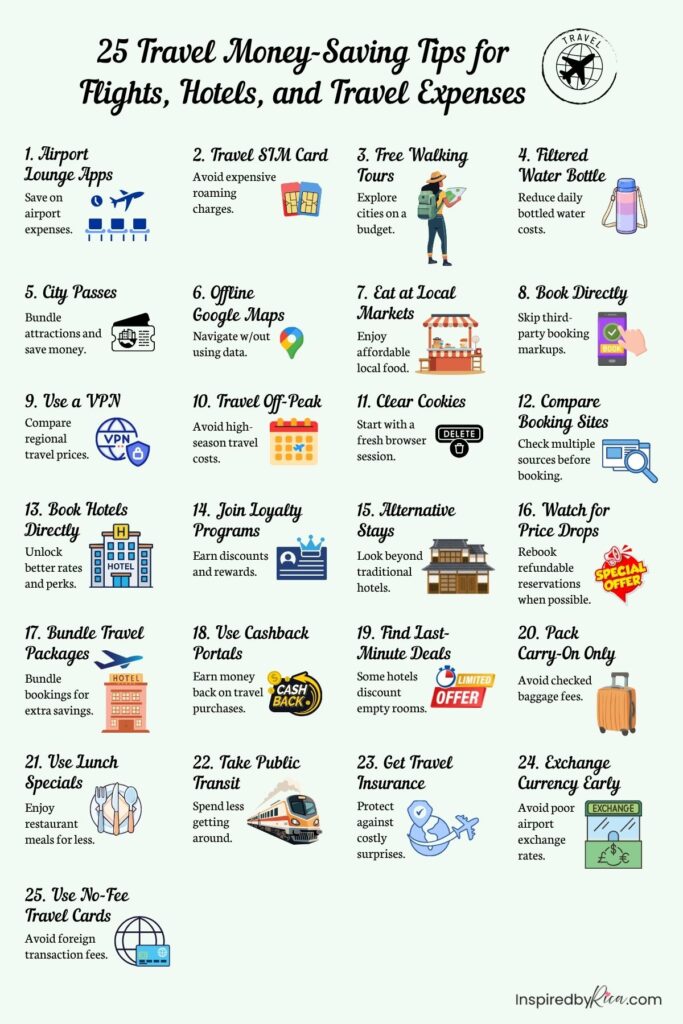
Visual Guide: 25 Travel Money-Saving Tips for Flights, Hotels, and Travel Expenses
You May Also Like
How to Find Cheap Flights: 15 Proven Booking Strategies
18 Smart Airport Hacks Frequent Travelers Always Use
18 Best Places to Visit in the United States for First-Time Travelers
12 Smart Ways to Avoid Airline Baggage Fees
15 Helpful Tips for Traveling with Friends
Takeaways: Travel Money-Saving Tips for Flights, Hotels, and Travel Expenses
Saving money on travel is often the result of smart planning rather than major sacrifices. Small decisions such as choosing affordable transportation, finding better accommodation deals, reducing food costs, using rewards programs, and avoiding unnecessary fees can add up to significant savings throughout your trip.
The best approach is to combine several of these budget travel tips to reduce costs on flights, hotels, transportation, and daily expenses. Save this guide for future trip planning, share it with fellow travelers, and come back whenever you’re preparing for your next adventure.