
Choosing the right shampoo and conditioner is about much more than picking a product with attractive packaging or a pleasant scent. The ingredients, formulation, scalp compatibility, and hair-specific benefits all play a major role in how well a product performs. Understanding the most important things to check before buying shampoo and conditioner can help you avoid wasting money on products that fail to address your hair’s actual needs.
Whether your goal is more moisture, volume, shine, damage repair, or scalp balance, making informed choices can dramatically improve your results. These essential tips will help you navigate product labels, understand key ingredients, and choose the best shampoo and conditioner for healthier-looking hair.
Disclaimer: This article is for informational and educational purposes only. Hair and scalp needs vary from person to person. Consult a qualified dermatologist or haircare professional for personalized advice.
1. Know Your Hair Type First
Before you even reach for a bottle, understanding your hair type is the single most important step. Fine hair needs lightweight formulas that won’t weigh it down, while thick or coarse hair needs richer, more moisturizing products. Buying the wrong formula for your hair type is the fastest way to end up with a product that just sits in your cabinet unused.
Tip: If you’re unsure of your hair type, observe how your hair behaves on the second day after washing.
2. Check the Ingredient List
The ingredient list tells you everything a pretty label won’t. Ingredients are listed in order of concentration, so whatever appears first makes up the bulk of the formula. Learning to read even just the first five ingredients helps you make a much smarter purchase.
Tip: If you can’t pronounce most of the ingredients, look them up on a site like INCI Decoder before buying.
3. Avoid Sulfates If You Have Dry or Color-Treated Hair
Sulfates are the cleansing agents that create that satisfying lather, but they can be incredibly stripping for dry, damaged, or color-treated hair. They essentially wash away the moisture and color your hair needs to look healthy and vibrant. Switching to a sulfate-free shampoo can make a noticeable difference in just a few washes.
Tip: Look for gentler cleansers like sodium cocoyl isethionate or cocamidopropyl betaine as sulfate alternatives.
4. Look for Silicone-Free Formulas
Silicones give hair that instant slip and shine, but over time they build up on the hair shaft and make strands feel heavy, limp, and coated. This buildup can also block moisture from actually penetrating the hair, which defeats the whole purpose of conditioning. If you notice your hair feeling weighed down even right after washing, silicone buildup could be the culprit.
Tip: Any ingredient ending in “cone,” “conol,” or “xane” is a silicone, so keep an eye out for those.
5. Choose Based on Your Scalp Condition
Your scalp is skin, and just like the skin on your face, it has its own specific needs that deserve attention. An oily scalp needs balancing and clarifying formulas, while a dry or sensitive scalp benefits from soothing, gentle ingredients like aloe vera or tea tree oil. Treating your scalp right is actually what leads to healthier hair growth in the long run.
Tip: If you deal with dandruff, look specifically for zinc pyrithione or salicylic acid in the formula.
6. Check for Fragrance Sensitivity
Fragrance is one of the most common causes of scalp irritation, itching, and even allergic reactions, and it’s often hiding in products that seem perfectly gentle otherwise. Many brands list “fragrance” or “parfum” as a single ingredient, which can actually represent dozens of undisclosed chemicals. If your scalp tends to be reactive, opting for fragrance-free products is always the safer choice.
Tip: Even products labeled “natural” can contain essential oils that trigger sensitivity, so always patch test when trying something new.
7. Match Shampoo and Conditioner from the Same Line
Shampoo and conditioner from the same product line are specifically formulated to work together, which means the ingredients complement each other rather than cancel each other out. Mixing random brands can sometimes create product conflict, leaving hair feeling strange or not quite right. Sticking to a matched set is especially helpful when you’re trying to address a specific concern like frizz, damage, or volume.
Tip: That said, once you know your ingredients well, mixing and matching strategically can also work beautifully.
8. Look for Key Beneficial Ingredients
Not all conditioning agents are created equal, and knowing which ingredients actually deliver results helps you cut through the marketing noise. Keratin, biotin, argan oil, hyaluronic acid, and panthenol are all ingredients with proven track records for strengthening, moisturizing, and improving hair health. The more targeted the ingredients are to your specific concern, the better your results will be.
Tip: Protein-based ingredients like keratin work best for damaged hair, while humectants like glycerin are better for moisture-deprived strands.
9. Check the pH Level
Hair has a naturally slightly acidic pH between 4.5 and 5.5, and using products that fall outside that range can cause the cuticle to lift, leading to frizz, breakage, and dullness. Most brands don’t print the pH on the label, but it’s worth checking the brand’s website or reaching out to customer service. Using a pH-balanced shampoo and conditioner keeps the cuticle smooth, which is what gives hair that healthy shine and softness.
Tip: A simple pH testing strip can help you check your current products at home in seconds.
10. Read Real Reviews Before Buying
Marketing language on a bottle is designed to sell you something, but real reviews from people with a similar hair type to yours tell the actual story. Look for reviews that go beyond “smells amazing” and actually describe how the product affected their hair texture, scalp health, and results over time. Trusted beauty communities, dermatologist recommendations, and before and after photos are your best tools for making a confident decision.
Tip: Filter reviews by your specific hair type or concern to find the most relevant feedback possible.
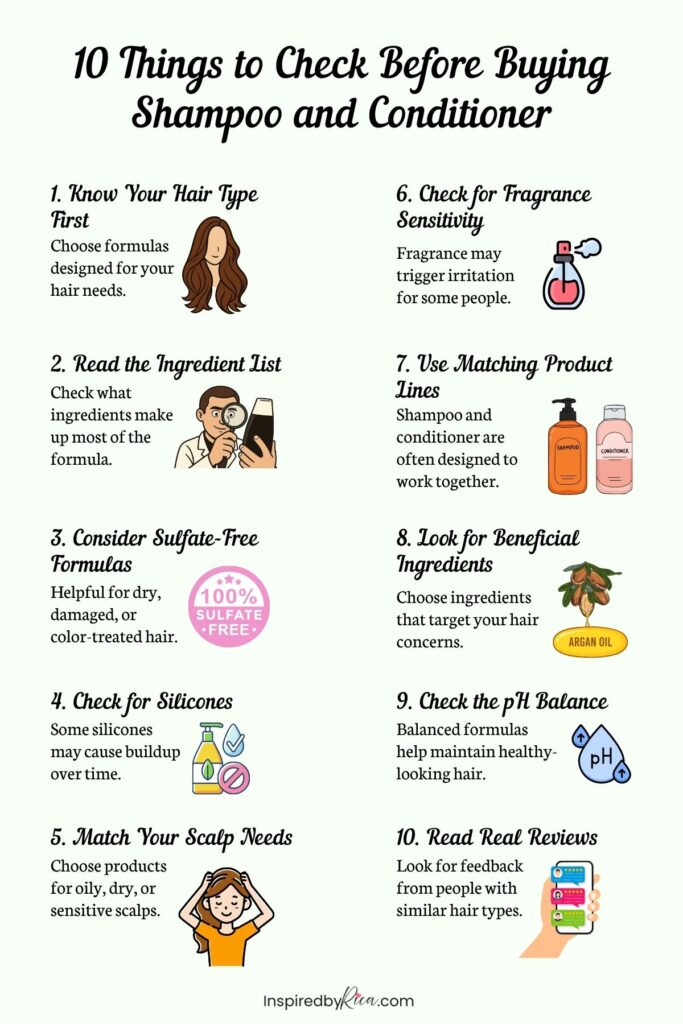
Visual Guide: 10 Things to Check Before Buying Shampoo and Conditioner
Frequently Asked Questions (FAQ)
How do I know which shampoo and conditioner are right for me?
Start by identifying your hair type, scalp condition, and primary concerns such as dryness, oiliness, frizz, damage, or color-treated hair. Choosing products formulated specifically for your needs typically delivers the best results.
Should I use sulfate-free shampoo?
Sulfate-free shampoos can be beneficial for people with dry, damaged, curly, or color-treated hair because they cleanse more gently and help preserve moisture. However, some people with very oily scalps may prefer stronger cleansing formulas.
Are silicones bad for hair?
Silicones are not inherently bad, but they can build up over time and make hair feel heavy or coated. Some people benefit from silicone-free formulas, while others enjoy the smoothness and shine silicones provide.
Does shampoo need to match the conditioner?
Using shampoo and conditioner from the same line can help because they are designed to work together. However, mixing products from different brands can also be effective when chosen based on your specific hair needs.
How often should I change my shampoo and conditioner?
There is no set timeline. If your current products continue to meet your hair and scalp needs, there is usually no reason to switch. Changes in season, hair condition, or scalp health may sometimes require different products.
You May Also Like
7 Simple Tips for Shiny & Healthy Hair
Haircare Routine for Oily vs Dry Scalp (Men & Women Guide)
12 Ways to Repair Damaged Hair from Heat Styling and Breakage
Takeaways: 10 Things to Check Before Buying Shampoo and Conditioner
Finding the right haircare products starts with understanding your hair and scalp rather than relying solely on marketing claims. Factors such as hair type, scalp condition, ingredient quality, pH balance, and potential sensitivities can significantly affect how a shampoo and conditioner perform over time. Taking a few extra minutes to evaluate these details can help you make a smarter purchase.
The best results come from choosing products that address your specific concerns and contain ingredients that support long-term hair health. By paying attention to labels, researching ingredients, and reading reliable reviews, you can confidently select hair care products that help keep your hair looking healthy, strong, and manageable.
Author’s Note:
I have a background in cosmetology and share practical, experience-based beauty and skincare tips. This content is not medical advice—please consult a licensed professional for specific concerns.